 biotiq

Hi all, it's Michiel.
We log public signals for the ESG and climate software vendors in our tracker, such as job posts and product launches. Those signals tell us when a vendor changes something. They say less about how it sells on an ordinary day. For this deep dive we looked at that ordinary day, for all 1,318 vendors in the tracker.
We did not survey anyone. Everything here comes from what a vendor shows the public on its website and in its DNS records. We added the LinkedIn and Google ad libraries, the job posts we collected, and the business model each vendor has in our SaaS map.
The short version is that most vendors who show a sales motion want a sales conversation first. Few publish prices. HubSpot is the tool we find most often, both in website scripts and in DNS records. And sales is the largest group of roles in the job posts we hold.
What we checked, and what a blank means
Our SaaS map holds 1,361 vendors, and the business-model split near the end uses the full map. Everything else covers the 1,318 vendors in the tracker. We ran the website and DNS checks in early October 2026.
For the sales motion we read the buttons and links on each homepage. A button to book a demo or talk to sales counts as sales-led. Buttons for a free trial or a new account count as product-led. A homepage can show both kinds of button, and we count those separately.
For pricing we looked for a pricing page linked from the homepage or listed in the sitemap. When that page showed an amount next to a currency, we counted it as public prices.
For tools we used two sources. The scripts a homepage loads reveal the CRM forms and chat tools a site uses, as well as ad pixels and visitor identification tools. DNS adds more. Many tools ask a customer to place a short text record on its domain to prove ownership, and those records are public.
For ads we searched LinkedIn's ad library and Google's Ads Transparency Center. We only did this for the 155 vendors with an ad pixel on their homepage. In LinkedIn's library we could check 134 of them.
A blank in any of these checks means we did not find something, and the vendor may still have it. Some homepages only show their text after JavaScript runs, and our reader then sees no buttons. A CRM that runs behind the scenes leaves no script on the website. A DNS record can also stay in place long after a vendor stops using the tool. So the website counts below are a floor, and the DNS counts can include tools that are no longer in use.
Sales-led where we can see it
The first chart sorts the 1,318 vendors by the buttons on their homepage.
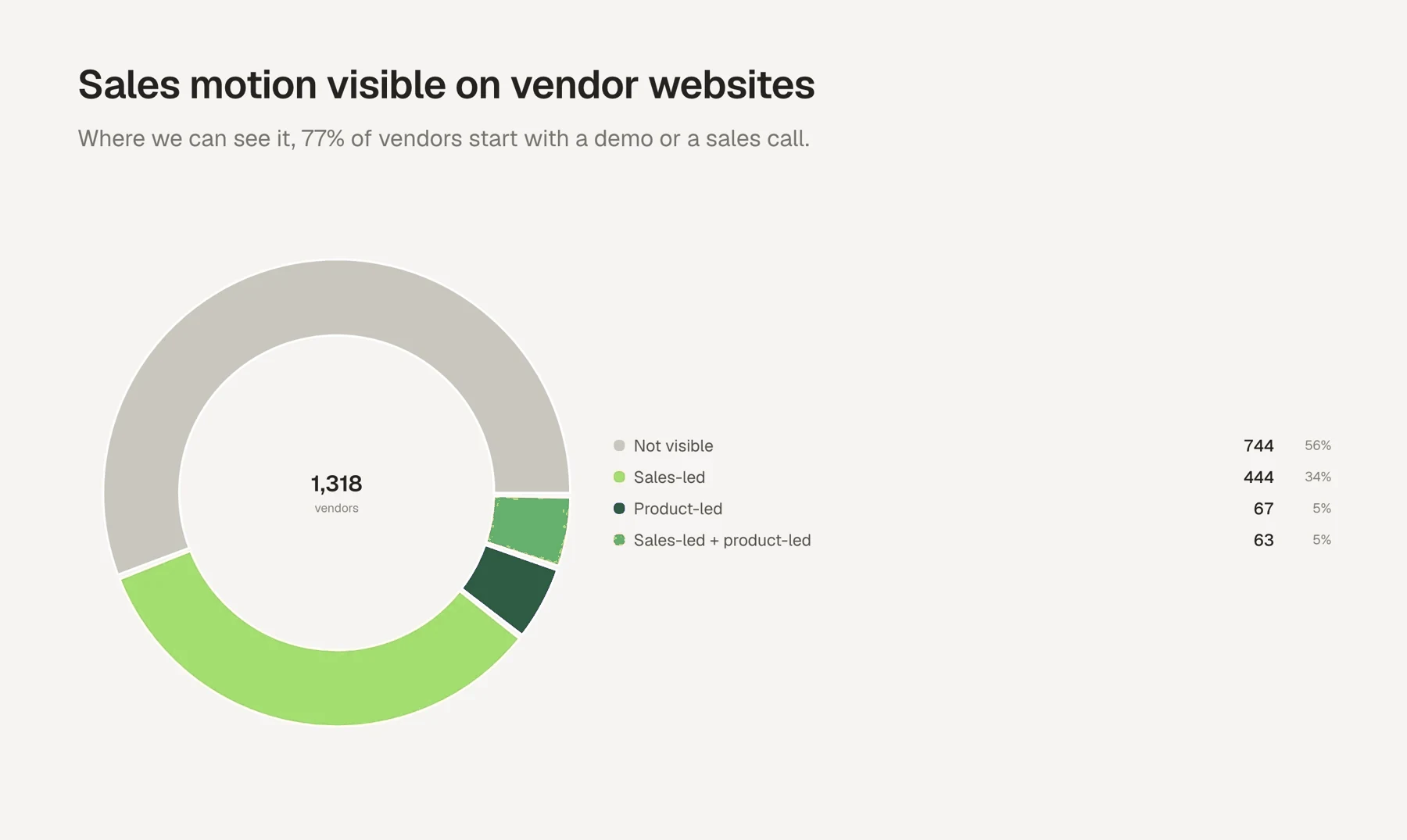
For 744 vendors, or 56%, the homepage showed our reader neither kind of button. Some of these sites only render with JavaScript, and others may keep the contact form one click deeper.
Of the rest, 444 vendors show only sales buttons. That is 34% of the tracker, and 77% of the vendors where a motion is visible. Another 63 show both kinds of button. Only 67 vendors, or 5% of the tracker, show a self-serve button and no sales button.
So where we can see how a vendor wants to start, it is usually with a demo. A CSRD report or a supply chain due diligence process tends to involve several departments at the buyer, and we think vendors use the first call to find out who else needs to agree.
Prices are rarely public
The second chart counts what we found on pricing pages, where one vendor can show several elements at once.
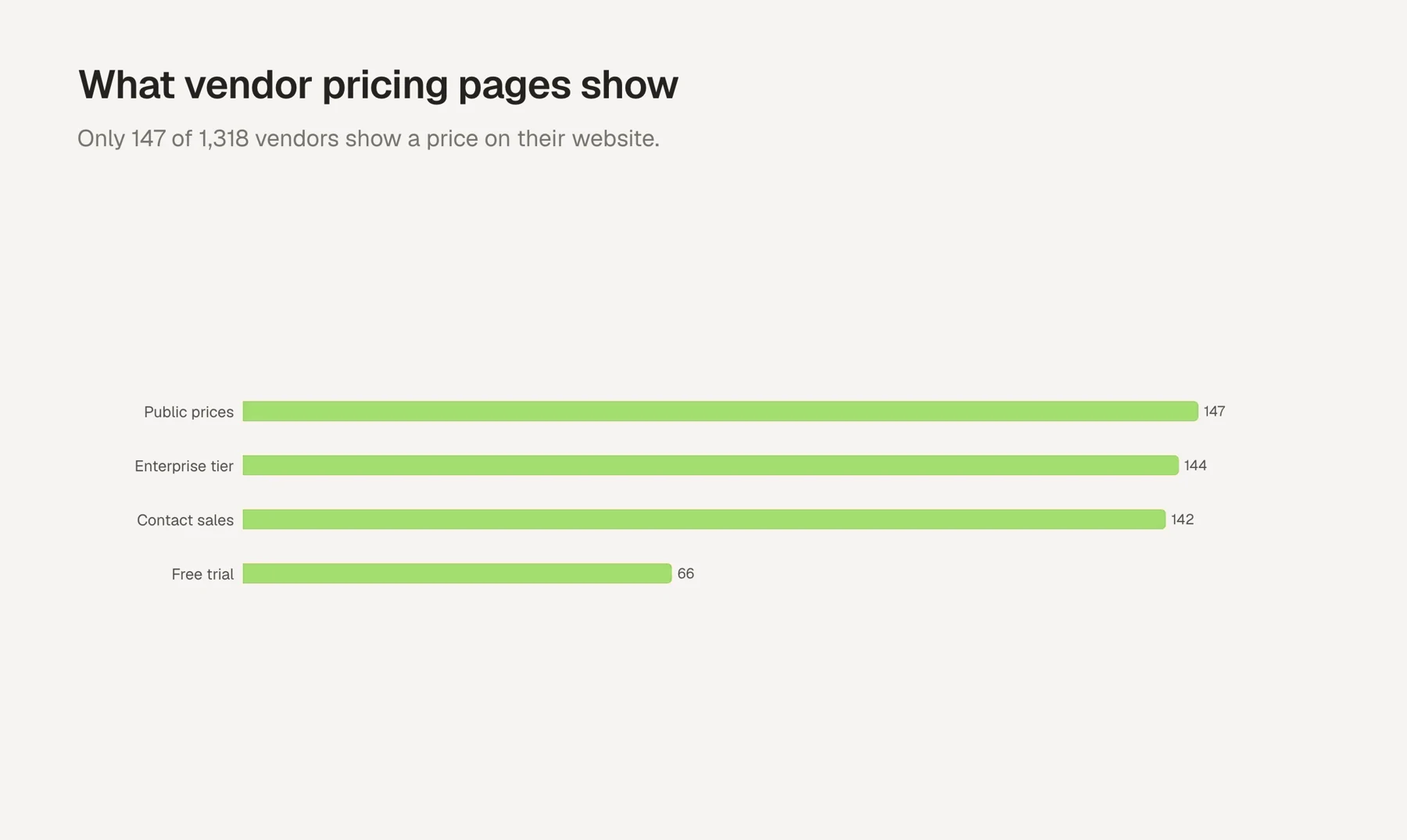
We found no pricing page for 1,103 vendors, or 84% of the tracker. A pricing page turned up for 215 vendors, and 147 of those pages show prices in a currency. That is 11% of all vendors in the tracker, and 68% of the vendors with a pricing page.
A pricing page can still leave the real price open. On the 215 pricing pages we found, 144 vendors list an enterprise tier and 142 ask the visitor to contact sales. A free trial appears on 66 of them, which is 31%.
For a buyer this means the first real price usually comes out of a sales conversation.
HubSpot is the CRM we see most
On the website we detected a CRM or a related sales tool for 153 vendors, which is 12% of the tracker. The chart below counts each tool we found on those sites.
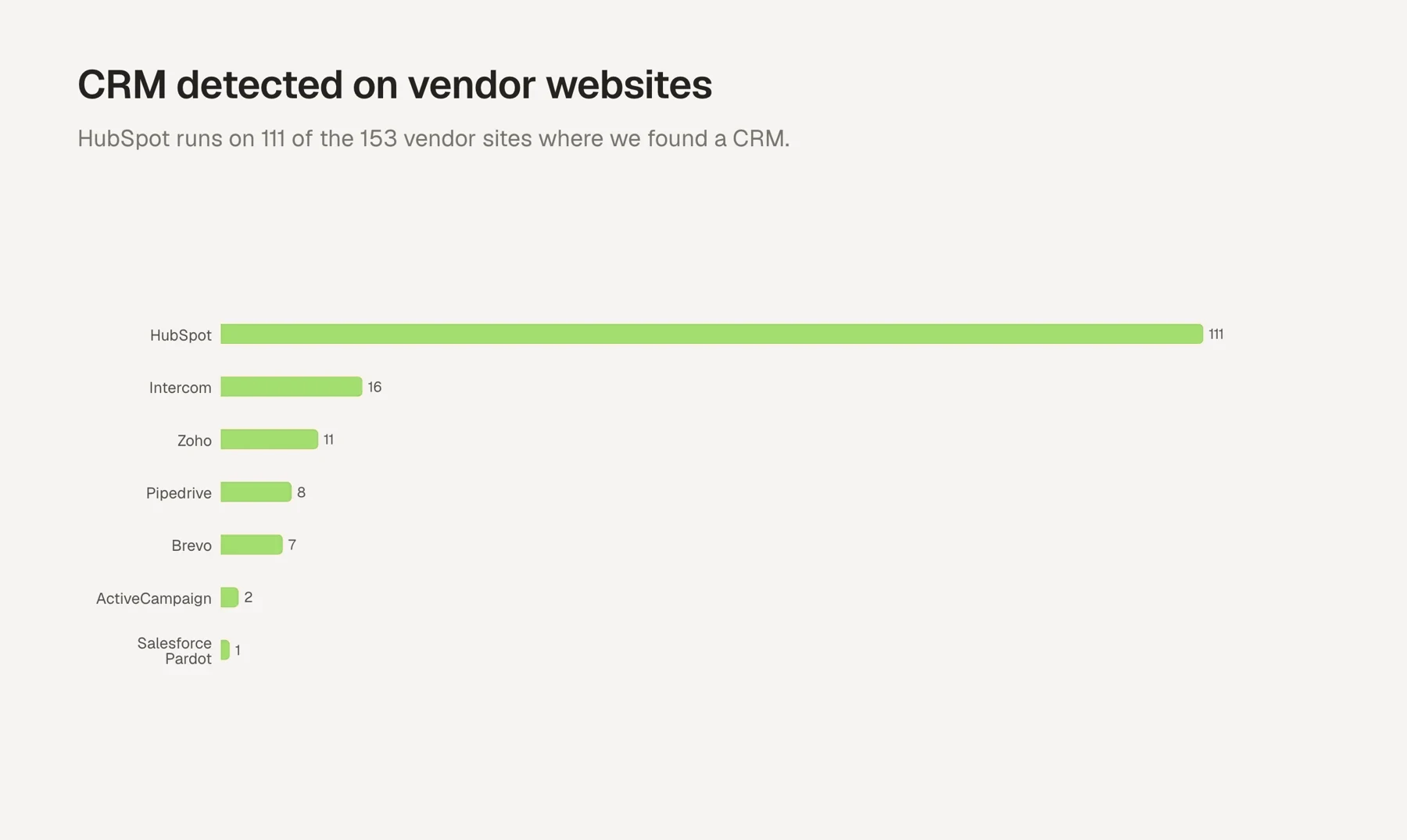
HubSpot accounts for 111 of those vendors, or 73% of the vendors where we found a CRM. Intercom follows with 16, then Zoho with 11 and Pipedrive with 8. Brevo shows up on 7 sites and ActiveCampaign on 2. We found a Salesforce script, from its Pardot marketing tool, on a single site.
DNS gives a wider picture. We found a HubSpot verification record for 340 vendors, or 26% of the tracker. Brevo has 149 records and Salesforce 47. The gap between 111 HubSpot scripts and 340 HubSpot records suggests a homepage scan misses a lot, though some DNS records belong to tools a vendor no longer uses. A vendor can use HubSpot for email or as its CRM without loading any HubSpot script on its homepage. Salesforce leaves even fewer traces on a website, so the single Pardot script tells us very little about how many vendors run Salesforce.
Sales email tools are rarer in DNS. We found a lemlist record for 15 vendors and an Apollo record for one.
Ads and visitor identification
An ad pixel lets a vendor measure visits from its ads and show ads again to people who visited. We found one on 155 homepages, or 12% of the tracker. The LinkedIn Insight Tag is the most common with 88, ahead of the Google Ads tag with 66. Meta's pixel sits on 22 sites. Microsoft Ads has 9 and TikTok has 2.
A pixel does not prove a live campaign. Of the 134 vendors we checked in LinkedIn's ad library, 38 had run ads in the last 90 days, which is 28% of those checked. In Google's Transparency Center, 48 vendors had an ad shown in the last 30 days, and 73 have run Google ads at some point. Vendors without a pixel were not looked up, and some of them may advertise as well.
As far as we can see, paid ads play a small part in how this market sells. Since 1 June we logged 53 signals for paid ads, against 187 hiring signals.
Visitor identification tools match a website visit to the company behind it, so a sales team can follow up. We found one on 79 homepages, or 6% of the tracker. Leadfeeder, which is now part of Dealfront, leads with 32. Apollo's website tracker follows with 26, and Leadinfo has 13.
App marketplaces barely show up. We found links to the AWS Marketplace on 3 vendor sites, to Microsoft AppSource on 2 and to the SAP Store on 1. We only read the vendors' own links, so the real number of listings can be higher.
Who vendors hire
Job posts show which teams vendors are growing. We collected 479 open posts at 135 companies in the tracker and sorted them by job title.
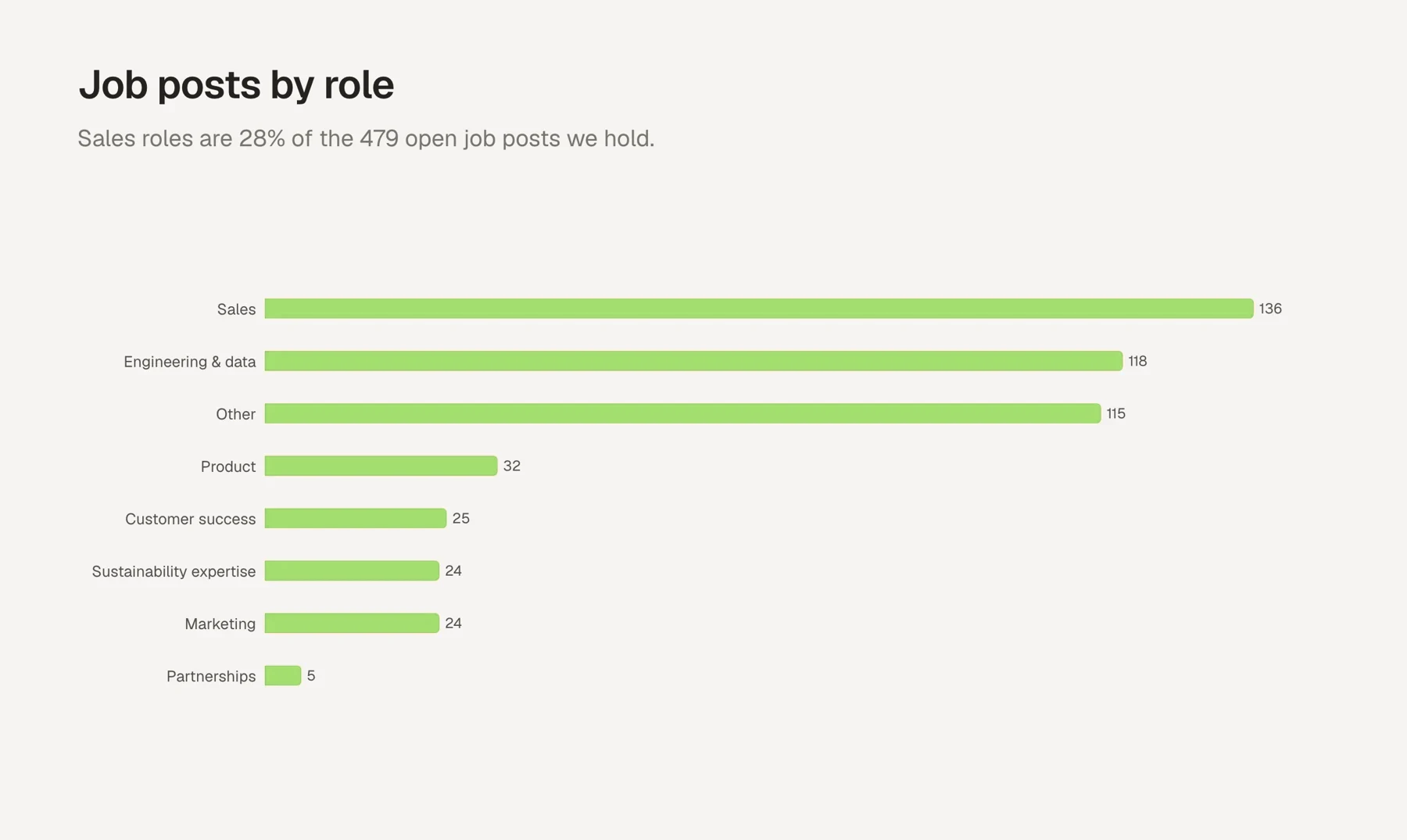
Sales is the largest group, with 136 posts, or 28%. Engineering and data follow with 118, or 25%. Another 115 posts fit none of our groups. Product has 32 posts, customer success 25 and marketing 24. Sustainability expertise also has 24, and partnerships has 5. Taken together, the roles in sales and marketing plus customer success and partnerships make up 40% of all posts.
Some of our hiring signals say more about the sales setup. 15 signals matched our code for a vendor that seems to be building outbound sales from scratch. Another 5 were for a GTM engineer or revenue operations role, and 2 for a partner manager.
Founder-led selling is harder to see from outside. For vendors with at least 15 staff, we counted the people in sales roles in public employee profile data, and we only used the count when that data covered at least half the staff. We found at most one person in sales at 66 vendors, and we mark those as likely founder-led. Another 42 vendors had two people in sales, which we mark as a thin sales team.
Software, with services on the side
The SaaS map gives each of its 1,361 vendors a business model, based on what its website says it sells. Pure SaaS is the largest group with 810 vendors, or 60% of the map. Another 378 vendors, or 28%, sell software together with services. A further 103 are consultancies with a tool of their own, and 70 are data providers.
So 40% of the map sells something other than pure software. We think that helps explain the demo-first pattern, because a service has to be scoped before it can be priced. It also puts many vendors close to consultancies, which can be competitors or partners. We hold 32 partnership signals for the vendors in the tracker.
What this means for a vendor planning its GTM
Where we can see a motion, most vendors in this market start with a demo, so a buyer who compares several of them has to book a call with each one before seeing a number. We think a clear public price, even for one plan, makes a vendor easier to put on a shortlist, and in this market it is still unusual.
Paid channels are quiet as well. A pixel sits on 12% of homepages, and 38 of the 134 vendors we checked had LinkedIn ads in the last 90 days. That leaves room for a vendor that advertises steadily, as long as its buyers spend time on those channels.
Sales is the largest group in the job posts, so a lot of new hiring goes into direct selling. For a vendor with a thin sales team, or a founder who still does most of the selling, a public price or a partner channel through consultancies can make each conversation shorter. That matters most when there are few people to have those conversations.
The charts are on the GTM Motion page of the platform, and each vendor's own page there shows what we found for it. If your company is in the tracker and something looks wrong, email us at info@biotiq.io and we will check it at the source.