More than 30,000 people work in Europe's sustainability consultancies.1 Most of the people I know in this field studied something related to sustainability and came here to make an impact. But most of these firms sell reporting: carbon footprints, EcoVadis assessments, ESG and CSRD reports, and the gap assessments that come before them.2
These are repeatable tasks that don't need much creativity, and AI can already do most of them. Looking towards 2030, these jobs might be affected.
For a sustainability consultant, that means figuring out the next step. If reporting is solved, we can finally move towards impact. I see three directions: become the check on what AI produces, move to physical risk, or move to physical impact.
This piece is for the consultants who might need to change what they do. I think it's good to at least start thinking about it. To test my assumptions, I spoke with four people. They have different roles and different views, but all of them work with AI and have an idea of where it is going. Let's first explore what the effects of AI might reasonably be.
Think of a day in the life of a sustainability consultant
You collect a client's energy bills and invoices, calculate the footprint, fill in the EcoVadis questionnaire and run a gap assessment. You write the report and present it to the board. And a lot of your time goes to talking with people.
The tasks are adapted from the entry for sustainability specialists in O*NET, the occupation database of the US Department of Labor, and from how consultancies describe their own services. Which task goes where is my own reading, not a measurement.
Some tasks stay with people
Interviewing stakeholders, training a client's team, presenting to a board, visiting a supplier's site, winning a client's trust. This is the work that needs a human touch.
AI helps with some tasks
It writes a first version and you decide what stays. Think of the reduction roadmap, the advice on what to cut first, the materiality assessment, the report or the answers to the auditor.
Some tasks AI can do on its own
Everything where there is a right answer you can check: processing the invoices, calculating the footprint, matching emission factors, filling in the EcoVadis questionnaire, mapping the CSRD datapoints and the gap assessment. And that is what most of these firms sell today.
There are new tasks too
Some come with the AI itself, like checking what it produced and setting the rules it calculates by. Others finally get time, like the physical risks at a client's own sites or reduction projects with suppliers.
So the day looks different
The calculating takes a fraction of the time, and more of the day goes to checking, advising and work on site. But the same reports also need a lot fewer hours. The rest of this piece is about the hours that are no longer needed.
My argument has three parts. For each one I added what the four people I spoke with think about it, including where they disagree with me.
1. The reporting work gets automated
In short, we looked for companies in Europe that sell ESG or sustainability services on their website, sorted what they sell into categories, and ended up with about 3,000 consultancies.2 Half of the firms we could classify sell ESG strategy and reporting, a third sell carbon footprints and a third sell CSRD work. Four in five sell at least one kind of reporting or measurement. A lot of that work exists because regulation or clients ask for it.
Most of that work you can check. An emission factor is right or wrong, and a calculation adds up or it doesn't. I think in general, work that is mathematically verifiable is what AI does well. For most Excel, Word and PowerPoint work in 2026, you just bring the ideas and the judgment, and the model does the rest.
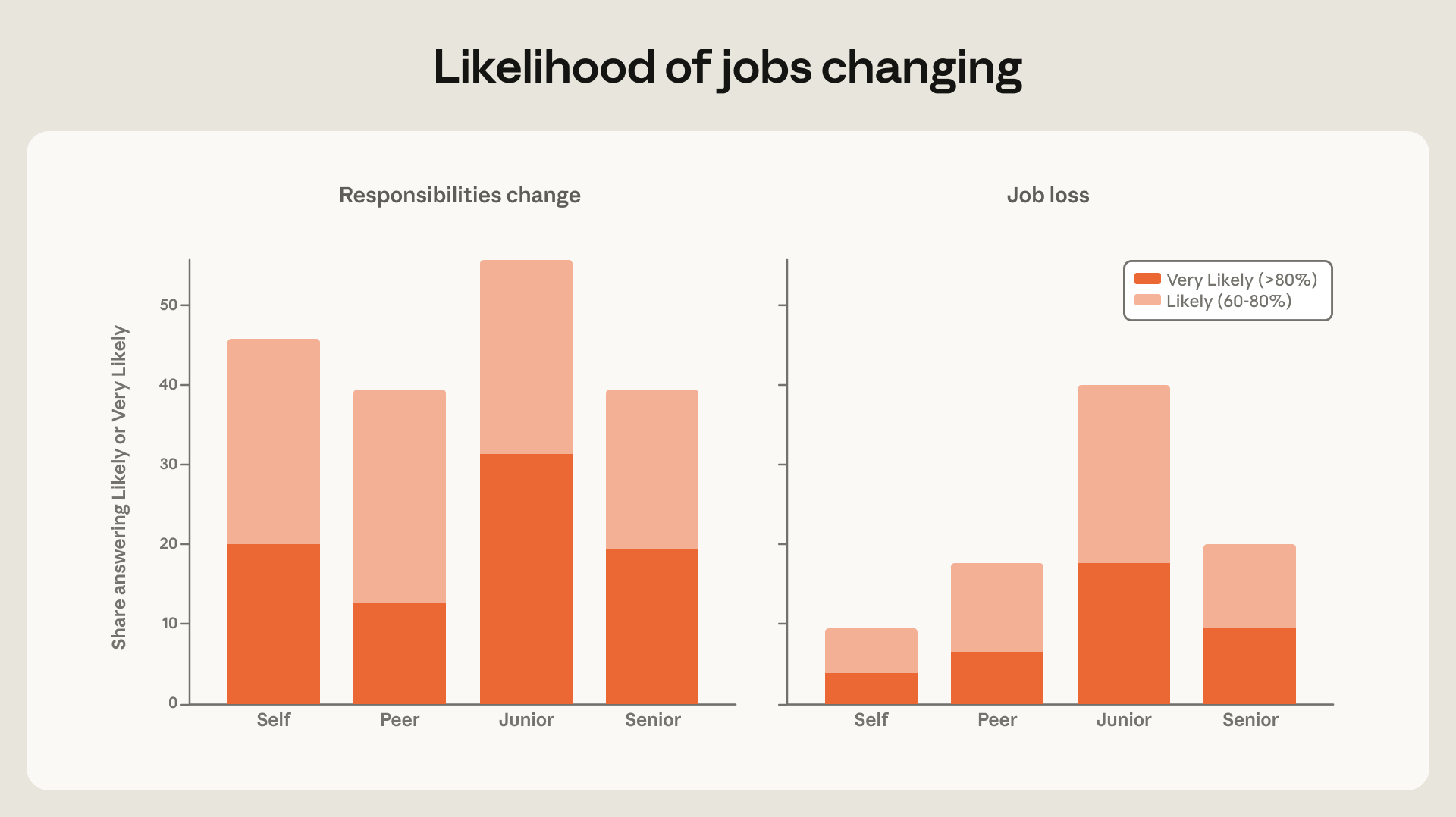
In a survey Anthropic published in June, among about 9,700 people who use its AI, more than a third expect their responsibilities at work to change significantly within a year. Many of them say judgment and management are what AI still lacks.3 PwC cut its UK entry-level intake for 2025 from 1,500 to 1,300. Its UK head pointed to a slower economy, and said "AI is reshaping roles".4 But none of this is about sustainability consulting.
How the four see it
Three of them said it plainly. Hannes Matt said you don't need a frontier model for this work. Beth Thayne called it "a perfect use case for AI". And Kenneth Van den Bergh, who sells carbon accounting software, said that having a number is no longer the hard part, because everyone can get one now.
Kenneth and Robin Dierckx add a condition. Carbon accounting is a compliance process, and an AI model won't necessarily give the same answer five times in a row. So everything that can be calculated with fixed rules has to be calculated with fixed rules, and the model only does the rest. That changes how the work gets automated, but I don't think it changes how many hours it saves.
What the firms sell. Share of the 2,527 consultancies whose services we could classify. See the map.
ESG strategy & reporting51%
Training & capacity35%
Carbon · GHG34%
CSRD · ESRS31%
EcoVadis16%
Circularity · EPR15%
Supply chain & due diligence13%
LCA12%
Energy8%
Nature · Biodiversity7%
EUDR3%
CBAM2%
Social · DEI1%
Sustainable finance<1%
Anthropic Economic Index, June 2026 · Figure 3.5More than a third of the people Anthropic surveyed think their responsibilities will likely change significantly within a year. About one in ten expect to lose their job. More than half of the respondents work in tech or management, not in our field. Still, I think it says something for us too. Far more of them expect their work to change than expect to lose their job.
What the firms sell. Share of the 2,527 consultancies whose services we could classify. See the map.
ESG strategy & reporting51%
Training & capacity35%
Carbon · GHG34%
CSRD · ESRS31%
EcoVadis16%
Circularity · EPR15%
Supply chain & due diligence13%
LCA12%
Energy8%
Nature · Biodiversity7%
EUDR3%
CBAM2%
Social · DEI1%
Sustainable finance<1%
Anthropic Economic Index, June 2026 · Figure 3.5More than a third of the people Anthropic surveyed think their responsibilities will likely change significantly within a year. About one in ten expect to lose their job. More than half of the respondents work in tech or management, not in our field. Still, I think it says something for us too. Far more of them expect their work to change than expect to lose their job.
2. The same work will need far fewer people
Kenneth thinks the market will grow a lot. Today at most 10% of mid-sized companies report their carbon footprint, and he expects that to go towards 70 to 80%. By 2028 he sees the money spent on it growing four times, and then adds: "Probably a bit ambitious, it will be more like post-2030 given the Omnibus and the current headwinds."5
To serve that market, he thinks it takes "more like maybe 50% more carbon accountants, and three times as efficient". That is four times the work with one and a half times the people. For the same amount of work, that means three to four people where you need ten today. My own assumption is three people instead of ten, so we're not far apart. Where we differ is how much more work there will be.
For a consultancy, that difference matters a lot. The graph shows three versions of it. If demand really grows four times, the efficiency gain gets absorbed and firms keep hiring. But this market is not in a great place right now, and I wouldn't assume it keeps growing everywhere. If demand grows more slowly, the same reports get made by far fewer people, and the price goes down with it. On the price, Kenneth agrees: "I also expect prices for reporting itself still have to come down, through AI and through more competitive pressure."
How the four see it
Robin thinks cheaper work can create more work. In legal, he said, faster and cheaper contracts did not lead to more contracts, and jobs were lost. But in software, cheaper code created far more work, because "everyone has infinitely more ideas than they can implement". In his view, sustainability can go the same way: "The sustainability problem is so big right now."
Hannes is closer to my view, and more blunt: "it might be that 80% of these ESG consultancies are dying because the market is getting so rough."
People needed for reporting work, 2026 = 100, under three demand scenarios. Every scenario assumes the work gets about three times as efficient by 2030, in line with Kenneth's quote and my own estimate. With four times the work and one and a half times the people, as in Kenneth's quote, the top line would end at 150.
People needed for reporting work, 2026 = 100, under three demand scenarios. Every scenario assumes the work gets about three times as efficient by 2030, in line with Kenneth's quote and my own estimate. With four times the work and one and a half times the people, as in Kenneth's quote, the top line would end at 150.
3. Move towards the physical, and start now
If reporting needs fewer people, the rest will need something else to do. I don't think they have to leave sustainability. I think they can move towards the part of it that happens in the physical world, and I see at least two directions there.
Physical risk. Think of a company farming grassland that is drying out, a site in a forest-fire zone, or a factory on a floodplain. These are business risks with money attached. And they need people who understand both the climate data and the business.
Physical impact. Helping companies actually cut emissions and restore land. That means reduction plans built on primary data from their own suppliers instead of database averages, and then working on the projects that follow.
This move is not easy. A client who hired you for its CSRD report won't automatically trust you with its flood risk. It will look for people who already know that work, and some of that work will be done inside the company instead of bought from outside. So I think it's best to start building that expertise now, while reporting still brings in money.
How the four see it
Hannes expects that what we call sustainability or ESG today "will be integrated into risk management, obviously, because the physical risks won't go away".
Beth thinks the most sought-after consultants will be "the ones who have accompanied other organizations through some sort of real-world transition to reduce their environmental impact."
Kenneth: "Reporting is nice, but we report in order to have impact."
Robin says what is still missing: high-quality primary data and a strong methodology. "Without primary data you can't do reduction plans."
How I did this
We mapped the market. Between May and July we searched for companies in Europe that sell sustainability consulting on their own website, and checked every one we found. That gave 3,159 firms in 32 countries. For each firm we noted its headcount band and the services it sells. The scope is advisory work, mostly laptop work: reporting, strategy, calculations and training. Engineering and field work are left out.
How the services were sorted. We read each firm's homepage and service pages and looked for the services it names, in its own language: a CSRD offer, a carbon footprint, help with EcoVadis. A service only counted when the text showed that the firm sells it to clients, as a listed service or a client case. A firm that only shows its own EcoVadis medal doesn't count as selling EcoVadis support. An AI model checked every match, and it could only reject a match, never add one. We then grouped the services into fourteen categories.2 A firm can sell several: two thirds sell two or more, 2.3 on average. For 632 firms the website didn't name a service clearly enough. They are on the map, but not in the percentages.
I talked to four people. I had an open conversation with each of them, starting from the same assumption: the cost of intelligence keeps going down. Then I asked what that means for the work, and what stays. I checked every interview quote in this piece word for word against the recordings, and all four approved their quotes before publication. One of Hannes's quotes is in wording he suggested himself.
Feedback on the text. Sophia Collis contributed to the copy with feedback.
The 30,000 comes from the headcount bands on the map. The notes at the end show how.1
Figure 1 3,159 sustainability consultancies across 32 countries, verified from company websites, May to July 2026. Click a country to isolate it; filter by headcount band. Netherlands: 399 firms, 216 of them with ten people or fewer.
Who is on the map. Consultancies by headcount band. See the map.
1-101,702
11-50736
51-250279
250+172
Unknown270
Who is on the map. Consultancies by headcount band. See the map.
1-101,702
11-50736
51-250279
250+172
Unknown270
Three scenarios
Where the consultants are in 2030
These are the three scenarios from point 2 again, but now in numbers of people. Start with a round 30,000. My rough guess is that 60 to 70% of their effort goes into reporting and measurement, so let's take the middle, 65%. Then let that reporting work get three times as efficient by 2030, and let demand for it grow four times, double, or stay the same. If demand doubles, about 6,500 of the people now in reporting would need other work. If it stays flat, about 13,000.
People in Europe's sustainability consultancies, 2026 and 2030
Demand doubles. One in three people in reporting needs other work.
For the people who need other work, I see three directions: become the check on what AI produces, move to physical risk, or move to physical impact. More in Three ways to move.
Reporting and measurement
Other advisory
Need other work
An illustration, not a forecast. Reporting work gets about three times as efficient in every scenario, and other advisory work is held constant. The 65% share of reporting is my own rough estimate.
People in 2030 by scenario, starting from 30,000: 19,500 in reporting and measurement, 10,500 in other advisory
Scenario
Still in reporting
Newly hired into reporting
Need other work
Other advisory
Demand ×4
19,500
6,500
0
10,500
Demand ×2
13,000
0
6,500
10,500
Flat demand
6,500
0
13,000
10,500
Four perspectives
Above, I used the four interviews to test my three points. Here each of them gets their own space, with what they see as the next step.
Kenneth Van den Bergh: from finding a number to checking it
Co-founder of Carbon+Alt+Delete, which makes carbon accounting software for sustainability consultants.
He compares carbon accounting to financial accounting. "Financial reporting is not rocket science either. But no way I'm going to do it myself, because it remains a compliance exercise. You don't want to make mistakes. So why would I take on the hassle of doing it myself, possibly with AI tools that are a bit of a black box, if I can just pay a competitive price for someone who takes it off my hands?"
So he doesn't see the advisor disappearing. He sees the role changing: less manual data crunching, and more "the specific advisory, the change management, the communication". In his view, carbon reporting becomes a yearly line in the budget, like the annual accounts.
He also sees the checking itself becoming a market. "That is another huge opportunity for auditors. And I'm actually glad about it, because it is exactly what happened with financial reporting. We are just going to reach that point faster... It is not about claiming you are net zero. It is about: is your number correct?"
Kenneth's view of the market: the share of companies with EUR 10 million to 1 billion in revenue that report their carbon footprint. He expects it to rise from at most 10% today towards 70 to 80% in the early 2030s.
Kenneth's view of the market: the share of companies with EUR 10 million to 1 billion in revenue that report their carbon footprint. He expects it to rise from at most 10% today towards 70 to 80% in the early 2030s.
Robin Dierckx: the hard part is knowing what is good
For Robin it comes down to quality. The problem is work of medium quality that looks convincing: "it is very hard to tell the difference between a good tool, a genuinely good tool, and a tool that says it is good... So for sustainability consultants that becomes a big challenge." And a tool that looks fine is easy to find: "An LLM will always be able to give you something."
So he expects the job to change: "The consultant's work will be to coordinate that tooling, do some quality assurance... The job will change enormously, but I don't think there will be less work."
Paying for quality. Robin prices his own product on correctness: "So you only pay for the lines that are correct... And if you were to find one material error in the file, you get the credits for the whole file back."
Not as cheap as it looks. Robin also warned that intelligence does not simply get cheaper. His own AI subscription costs him 90 euros a month, and the same usage through the API would cost forty times as much.
Paying for quality. Robin prices his own product on correctness: "So you only pay for the lines that are correct... And if you were to find one material error in the file, you get the credits for the whole file back."
Not as cheap as it looks. Robin also warned that intelligence does not simply get cheaper. His own AI subscription costs him 90 euros a month, and the same usage through the API would cost forty times as much.
Hannes Matt: the models are ready, the people are not
Has built open geospatial data tools and a database of ESG risk vendors, advises startups, and is based in Berlin.
For Hannes, it's people who set the speed. "There won't be a point of acceleration, because the technical capacity is not the limiting factor." Municipalities, SMEs and many companies "are simply slow", and working with them "involves some aspects of a coach's or even therapist's work."
His advice to me. "I would focus on all the things that are financially material today. Like some of the points I made, risk management for financial institutions and insurers."
His advice to me. "I would focus on all the things that are financially material today. Like some of the points I made, risk management for financial institutions and insurers."
Beth Thayne: the value is in real-world change
Product leader in climate tech and regenerative agriculture, now working as a fractional head of product.
"I think for a very long time as an industry we have been very focused on data gathering and measurement and reporting, and all of that stuff is so important... I think, however, that work was always kind of the easy work. And yet it was the work that we sold as most valuable to our clients and to our customers. And I think we hid a lot behind the complexity of the frameworks, and we've almost built this entire false industry out of it." She called it "the very cynical viewpoint that I'm coming from".
She also expects the reporting work to go: "I think a lot of that work can be automated... So a lot of that work will go away. And historically, that's what we've charged for when we offer sustainability as a service." And she asked what happens to the people. "The missing piece for me is always, OK, you automate the work of these people, but you have no vision for what it is that they're supposed to do instead." At a previous company, her team built one tool to replace the spreadsheets of 300 customer managers. Most of them had masters or PhDs in energy transition, sustainability or agronomy, and they didn't know what their work would be once the tool was there.
Her hope is about the people who fill in the surveys: "I would love to see an emergence of sustainability ESG data focused translation layer tools so that nobody needs to be filling out surveys anymore." And she thinks every organisation should ask itself: "When this particular part of the work no longer exists, what's the work that we do?"
What she wrote afterwards. After our conversation, Beth posted on LinkedIn what she hopes AI does to this field. She hopes the field stops selling data gathering and reporting as a service, spends the freed time accompanying real-world change, and keeps AI invisible for the farmers and fishermen who should not have to use it. "The ones who win will be the ones who not just advise, but actually drive and execute transformation."
What she wrote afterwards. After our conversation, Beth posted on LinkedIn what she hopes AI does to this field. She hopes the field stops selling data gathering and reporting as a service, spends the freed time accompanying real-world change, and keeps AI invisible for the farmers and fishermen who should not have to use it. "The ones who win will be the ones who not just advise, but actually drive and execute transformation."
Towards a comprehensive view
What I take from the conversations and the numbers, and where I think the work could go next.
Reporting is not impact
Reporting is not impact. It's just the step that's necessary for impact. But for years, most of the money in this field went to that step and not to what comes after it. That's where the regulation pointed.
What stays with people is the work you can't check with a calculation: the human touch, trust, a moral or aesthetic judgment, knowing which risk matters for this particular company. My assumption is that a lot of the rest will get automated.
I don't think every company will take the reporting in-house. I think the expertise stays with the consultancies, but the price of a delivery goes down, and the number of people with it. That only changes if the market grows fast enough to keep everyone busy, and after the Omnibus I wouldn't bet on it.
So I think we as a profession need to realise that reporting and carbon calculations are being solved, and that we have to move beyond compliance work that can be automated. Towards physical risk, because that is where the money definitely is. And towards real impact, like new infrastructure and carbon projects, whether that is voluntary or driven by regulation, because that is where the focus needs to be.
Primary data and direct measurement are a nice next step, but on their own they are still reporting, and they still don't go to action.
Cheaper reporting also frees up money. As I read Hannes, budgets will go mostly to physical risk, because there is a financial incentive behind it. My hope is that more capital can be unlocked for the risks nobody is addressing today. That is just a hope, and I'm a bit cynical that it will happen. But cheaper reporting at least creates the conditions for it.
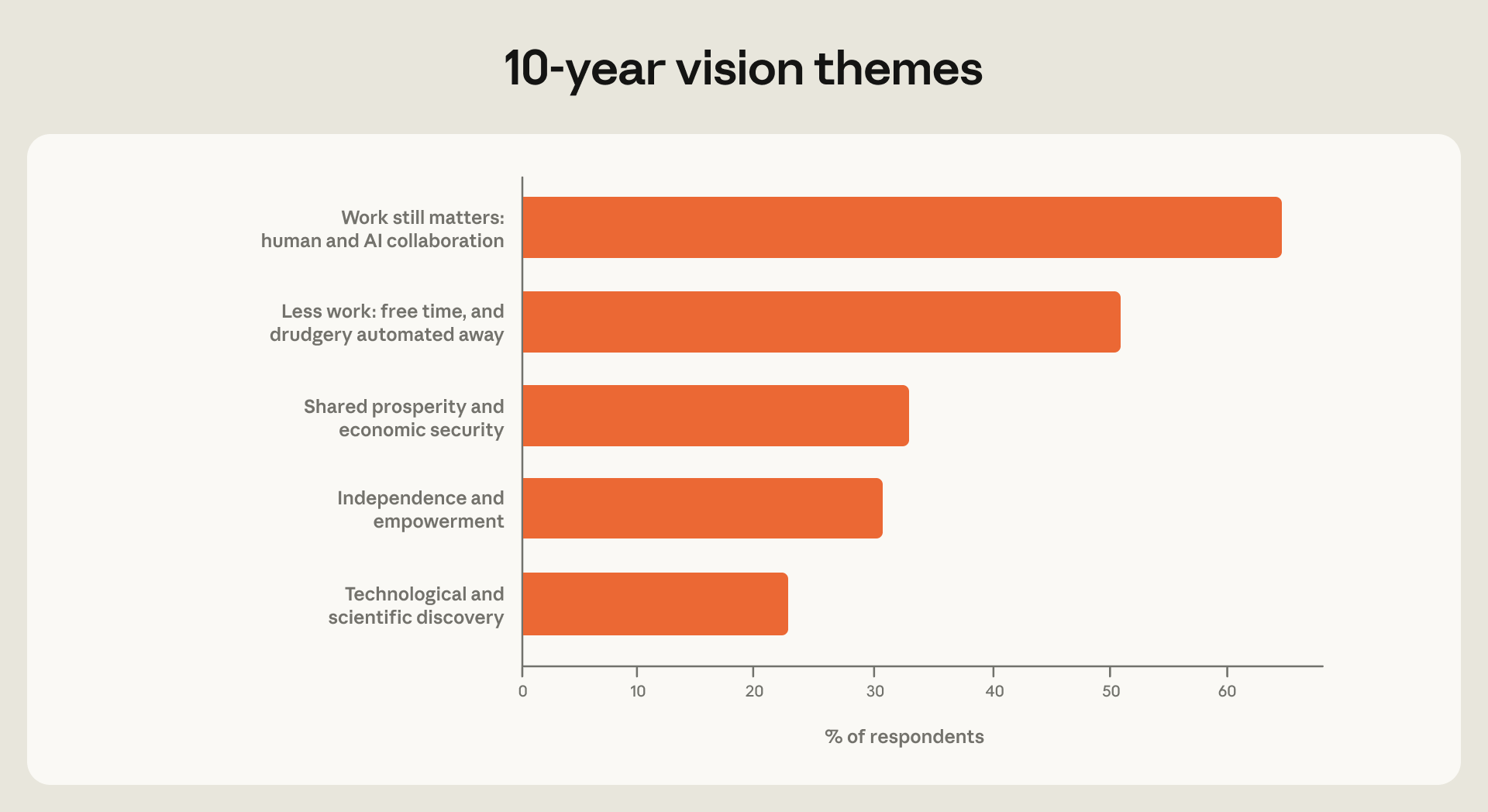
Anthropic Economic Index, June 2026 · Figure 3.9When Anthropic asked the same people what they hope an AI-transformed economy looks like in ten years, the most common answers were working with AI on meaningful work, automating the drudgery, and sharing the gains widely. For our field, I think a lot of the reporting falls under the drudgery.
Three ways to move
If most of your hours go into reporting and CO2 calculations, these are the directions I see.
Become the check. Keep doing the reporting, with fewer people and more tooling, and sell what the model can't sign for: a number that is correct and that you can explain to an auditor. I think there could also be bodies that test and accredit AI tools, and the consultancies that work with them, the way auditors and verifiers are accredited today. Expect lower prices and fewer people per report.
Move to physical risk. Learn how floods, drought, heat and fire hit your clients' sites and supply chains, and help them decide what to do about it.
Move to physical impact. Work on the projects themselves, like supplier programmes, land and water. This is where Beth expects the most sought-after consultants to end up.
And ask yourself this, in Beth's words: "If you weren't doing this repetitive work that you were doing, how would that time be spent?... What impact could that unlock? What expertise is sitting in your brain?"
Notes
About 30,000 people work in the 2,438 consultancies on the map with fifty people or fewer: 31,800 if every firm sits in the middle of its headcount band (5.5 and 30.5 people), 26,900 at 5 and 25 people. The 451 larger firms add more people, so the total is higher, but we cannot tell how much of their headcount works on sustainability. 270 firms (8.5%) have no headcount on record. See the map.
We found the consultancies by searching company websites for sustainability consulting services, between May and July 2026, and sorted each firm's services into fourteen categories. Of the 2,527 firms whose services we could classify: ESG strategy and reporting 51%, training and capacity 35%, carbon and GHG 34%, CSRD and ESRS 31%, EcoVadis 16%, circularity and EPR 15%, supply chain and due diligence 13%, LCA 12%, energy 8%, nature and biodiversity 7%, EUDR 3%, CBAM 2%, social and DEI 1%, sustainable finance under 1%. A firm can sell several. Four in five sell at least one kind of reporting or measurement (EcoVadis, CSRD, carbon, LCA, or ESG strategy and reporting). See the map.
Anthropic Economic Index report: Cadences, 26 June 2026. A survey of about 9,700 Claude users. The report itself notes that the respondents are not representative: they lean heavily towards computer, mathematical and management occupations. Figures in this piece are Anthropic's, reproduced with credit.
The Omnibus I Directive, Directive (EU) 2026/470, was signed off by the EU Council on 24 February 2026. From financial year 2027, CSRD reporting only applies to companies with more than 1,000 employees and more than EUR 450 million in turnover.